
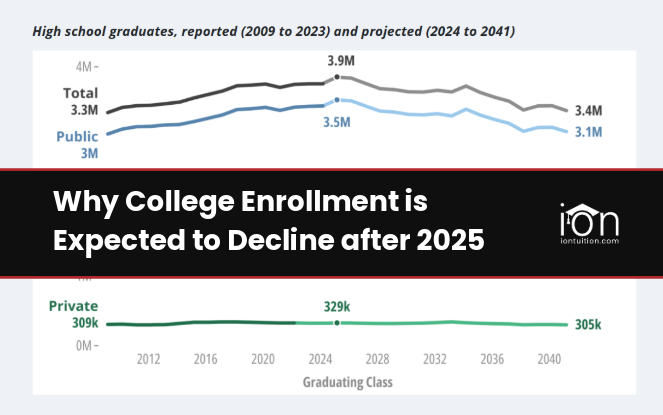
At the start of the year, we wrote about the upcoming “demographic cliff” in higher education. The warning was simple: the decline in birth rates during the 2007-2009 Great Recession will soon catch up to colleges. While some schools are experiencing record enrollments this year, the outlook beyond 2025 paints a different picture.
Peak Year for High School Graduates
According to the Western Interstate Commission for Higher Education (WICHE), 2025 will mark the peak year for high school graduates in the U.S. Beginning next year, the number of graduates is expected to steadily decline for the next 15 years, bottoming out around 2041. The enrollment shift is no longer theoretical—it has begun.
Regional Impact: Not All Declines Are Equal
The demographic college enrollment cliff will not affect every region equally. Because most colleges depend heavily on local applicants, geographic trends matter more than ever:
- West: A projected 20% drop by 2041, led by California (-29%), Hawaii (-33%), and Wyoming (-23%). A few states, such as Idaho and Montana, may see modest increases, but not enough to offset the regional decline.
- Midwest: A 16% decline overall, with sharp decreases in Illinois (-32%) and Michigan (-20%). Other states in the region will also experience double-digit drops.
- Northeast: A 17% decrease, driven by New York (-27%) and Pennsylvania (-17%). New Jersey is the only state expected to remain relatively stable.
- South: The only region projected to grow, though not fast enough to balance national losses.
Adding another layer of complexity, urban schools are expected to see declines of more than 97,000 high school graduates by 2033, while rural areas may see modest growth. Hyper-local data will play a critical role in shaping effective enrollment strategies.
More Than Birth Rates: Other Enrollment Challenges to Overcome
While the demographic cliff is rooted in population trends, other factors are compounding the problem:
- Declining Perceived Value: Many families now question whether a degree guarantees career success. Institutions face growing pressure to prove return on investment.
- Student Debt Concerns: With $1.6 trillion in outstanding federal loans, debt stigma remains high. Families want assurance that borrowing won’t derail future financial health.
- A Buyer’s Market: With fewer students to recruit, prospective students hold more leverage. Colleges will need to be more creative, flexible, and student-centered to remain competitive.
These forces are already contributing to financial strain across higher education. Nearly 20 nonprofit colleges closed in 2024, and more are at risk if they don’t adapt.
Turning the Cliff Into a Strategic Opportunity
The enrollment cliff doesn’t have to be catastrophic. Institutions that thrive will be those that:
- Use data-driven strategies to anticipate shifting enrollment pools.
- Strengthen speed-to-lead times and optimize the admissions process.
- Build long-term student relationships, from first inquiry through repayment support.
IonTuitin’s LinQ solution helps schools boost enrollment by leveraging our proprietary technology and our Call Center as a Service. Combined with our Default Aversion platform, schools can enjoy end-to-end support for the student lifecycle.
The demographic cliff is here, but with the right tools, it can be managed. Contact us at sales@iontuition.com to turn today’s enrollment challenges into tomorrow’s opportunities.